
MetaGEAR Platform

Microbiome research, end‑to‑end.
A Nextflow pipeline, a hosted gene portal, and a CLI — built at the Schirmer Lab to take shotgun metagenomes from raw reads to biological hypotheses.
One Nextflow pipeline, ten composable workflows.
Built on nf-core conventions. Profile a cohort against reference databases, or assemble it and get gene catalogs, viruses, bacterial genomes, species pangenomes and protein structures — reproducibly, on a laptop or an HPC cluster.
Scroll the figure sideways to see the full width.
- Gene- and genome-resolved together. One assembly yields the cohort gene catalog and the dereplicated MAGs.
- Viruses and plasmids alongside. Detection, host prediction, lifestyle calls and plasmid typing, in the same run.
- Structures for the dark matter. 3Di prediction and structural search recover function where sequence homology leaves proteins unassigned.
- Presets share the expensive work. Later workflows read what earlier ones produced instead of recomputing it.
Query bacterial genes against cohorts the pipeline already processed.
Explorer serves the gene catalogs produced by the pipeline above. Bring a sequence, a Pfam domain, or an MSP identifier and get back where it shows up across uniformly-processed cohorts — with cohort and sample metadata attached to every result.
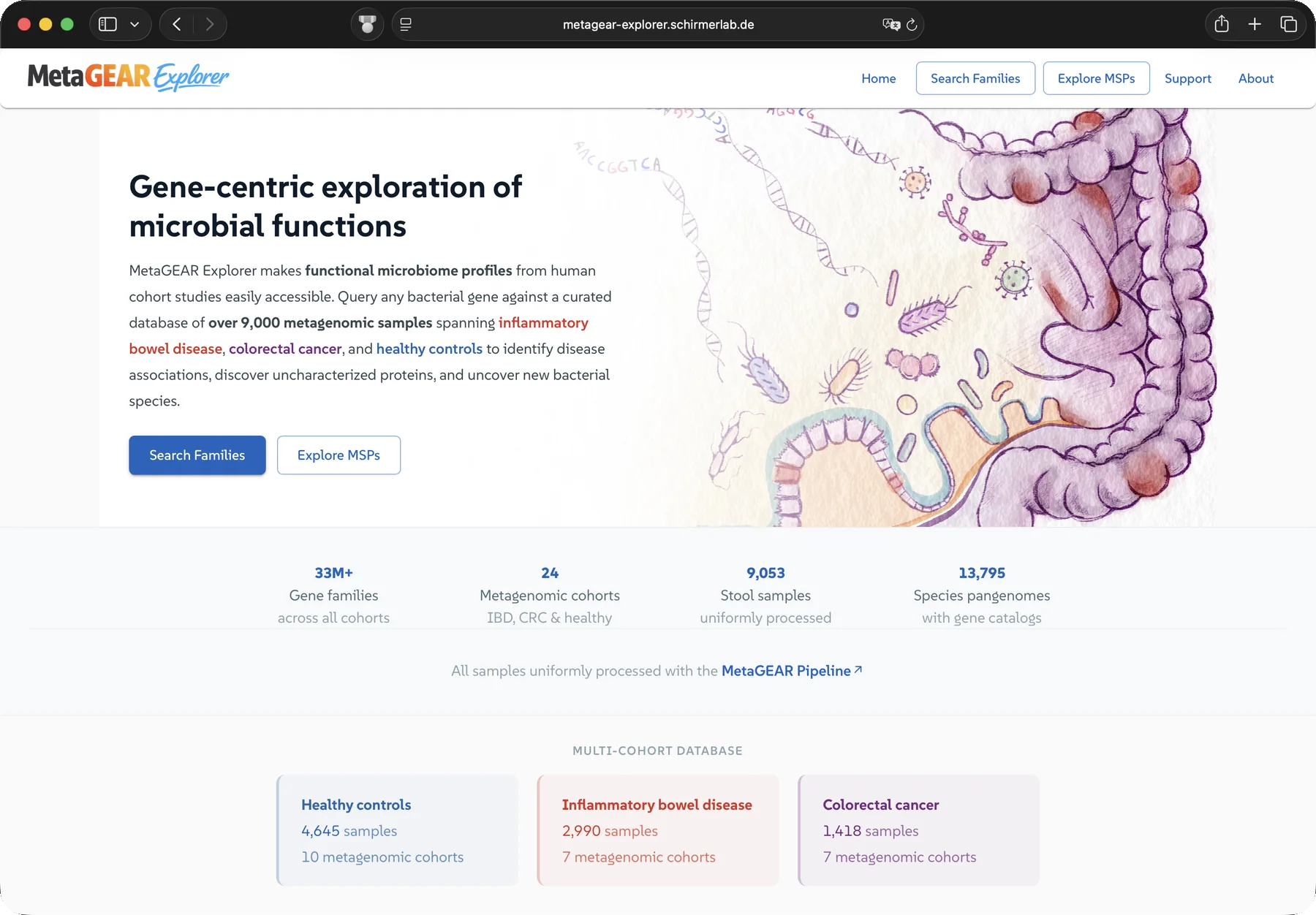
- BLAST a nucleotide or protein sequence against cohort-wide gene catalogs.
- Browse by Pfam domain (e.g.
PF08020) to find every gene that contains it. - Explore MSPs — MetaSpecies Pangenomes built from each cohort’s own gene catalog.
- Filter by cohort: IBD, CRC, healthy controls. Every hit traces back to its sample.
Install the pipeline. Run a workflow. Skip the Nextflow learning curve.
A small command-line wrapper that installs the pipeline, detects your hardware, manages reference databases, and runs workflows and presets with one command.
- Hardware-aware: sets resource limits to ~80% of available CPUs and RAM.
- Version-locked: installs the matching pipeline release.
- Presets built in: one command runs a whole chain in order.
- Multi-machine:
metagear clusterspreads a cohort across nodes.
Cite the work that matches what you used.
MetaGEAR Explorer: rapid query of microbial genes across cohorts
The Explorer portal and its underlying gene-centric query infrastructure. Cite if you used Explorer or the API.
Gene-centric methodology for metagenomic analysis
The methodology underlying the MetaGEAR Pipeline’s gene-centric analysis. Cite if you used the pipeline or extended the methodology.
An applied study using the MetaGEAR Pipeline
A peer-reviewed study that applied the pipeline to a microbiome research question. Cite alongside the methodology paper for similar work.


